Blogger Widgets
Home Expenses Plant Guides Mine Downloads

Bangor Rainforest construction abandoned

Thursday, August 13, 2015  at 8:26 PM 0 comments
The attempt at creating a rainforest on the Bangor property has been cancelled due to new people moving into the property and the introduction of cows and sheep to the paddock in question. My hands are officially tied and I have had to cease all planting activity approximately 2 years ago. The new people who moved in had other ideas for the paddock. As a result the entire property, now minus at least 3-4 large trees and reduced amounts of underbrush, has become hotter and drier. With the invasion of more snakes, including migrating Tiger snakes that have set up home on the property, at the going rate of progress, the habitat of Bangor will continuously decline to one of a hot, dry habitat.

With that said and done, I am now focusing my attention on my own garden and trying to create a subtropical garden but on a much smaller scale. I have a blog just for that here.

Inspiration has hit me

Sunday, March 17, 2013  at 3:34 PM 0 comments
Whilst browsing the internet on more ideas for revegetating the Tenterfield Creek, and trying to find ways to prevent seedlings from being washed away in floods I came across this article: http://www.wetlandcare.com.au/index.php/our-work/successful-projects/wetland-restoration-and-rehabilitation/northern-nsw-upper-tributaries-rehabilitation-project/

It mentioned how they planted seedlings deeper than normal, almost burying the entire seedling into the ground. Apparently this technique, called "The long stemmed planting technique" has a really high success rate of seedlings not being washed away in times of floods. The next time I buy seedlings I will try it out.

If it doesn't work then I will be at a loss on how to revegetate the Tenterfield Creek successfully. But I have to keep my hopes up. Something has to work!!!

Water still flowing into creek

Friday, March 8, 2013  at 10:57 PM 0 comments
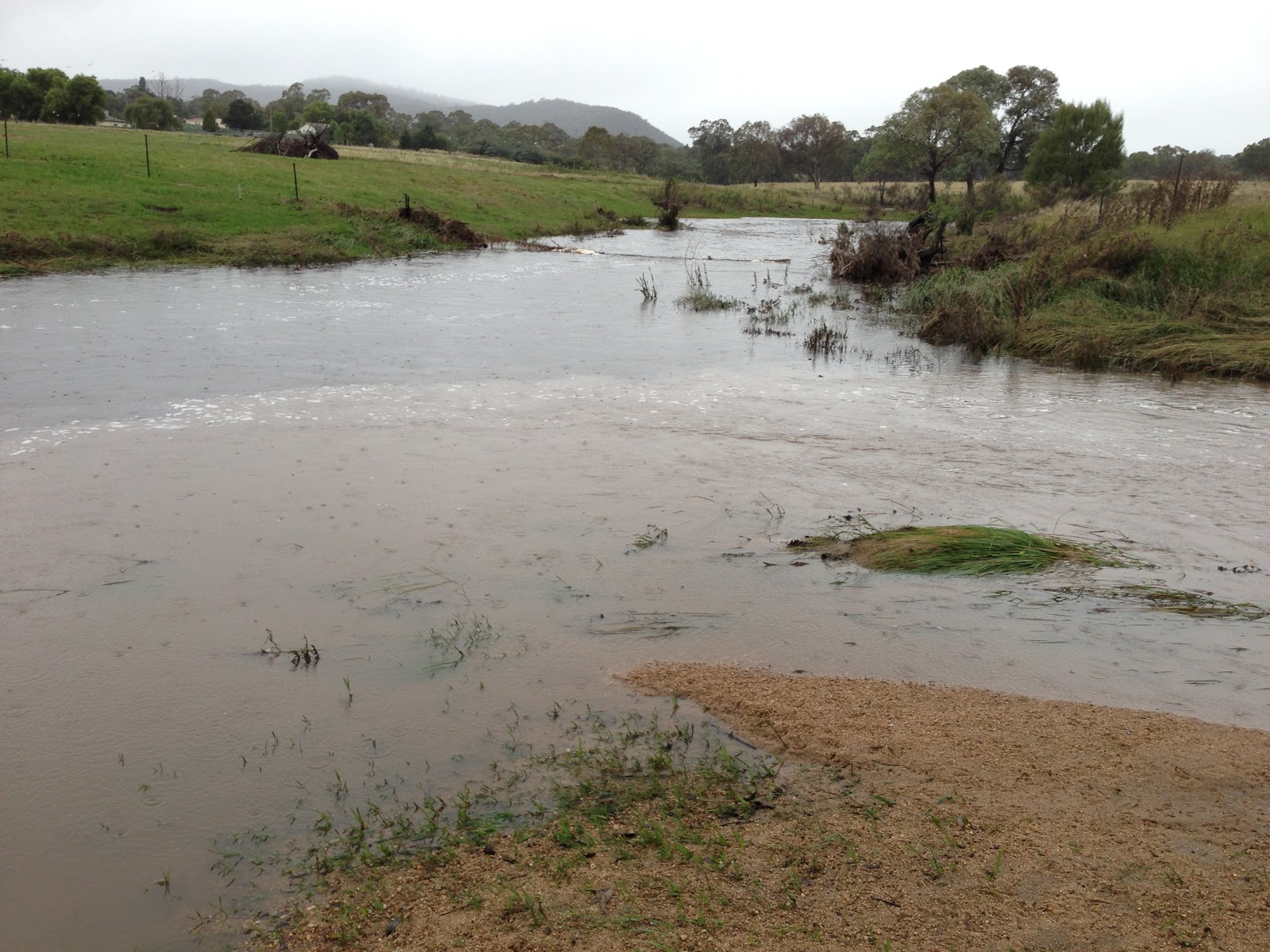
It has been a few days since the rain has stopped but when I was taking photos of the creek yesterday I noticed the creek was still flowing. The water level was up pretty high still and water is still flowing over the top of our other neighbour's driveway. The water is coming down from MT. McKenzie still. During even a major flood this does not happen as the water subsides quickly.

Here are a few pics from yesterday of the creek.

After view: Creek from the Douglas Street bridge looking south.
Australian Wood Ducks in the foreground.
When I enlarged the image above I noticed how high the sand had been backfilled on that corner. As you can see the sand is much higher in this area than any other point lower down near the water itself. Also the slope of the creek bank has been altered from a steep slope to a gradual decline then it flattens out near the water. There was a build up of sand in the immediate area on that corner beforehand but nothing like it is now. The forces of nature needed to create such a restructure of the creek and bank is beyond the power of us mere mortals.

Before view: photo taken 28 January 2013. Before all the sand and rock
debris was relocated along the Tenterfield Creek.
Where one of the seedlings was planted.
As this section of the creek has altered since the last flood occurred I cannot tell if these bamboo sticks were where the remaining gum tree seedling was planted or whether it was where the bush was planted. They were both planted within 5 feet of each other. I was surprised the bamboo sticks were still in the ground.

Water still flowing across the driveway.
Yesterday's pic of the water still flowing into the creek at the back of my neighbour Carol's property. When overflowing the water rushes over this driveway. I am surprised to still see water going over the driveway. The water on the other side of the driveway is where the water comes from MT. McKenzie which you can see in the distance behind the gum trees at centre and centre left of this photo.

Close up of the water flowing across driveway.
Currently it is still trying to rain. The sun came out today making me believe all the clouds were clearing up but apparently not as it is overcast again and sort of raining as I write this post. I very much doubt that the creek's water level is going to drop any time soon.

Seedling death toll is grim

  at 7:57 PM 0 comments
Yesterday I was able to do a death toll of all the seedlings I had planted in the creek or within 6 feet of it. Out of the 13 seedlings I planted within this zone only 2 have survived. The 2 survivors are Flooded Gums which have not escaped injury. They have been bent over and slightly uprooted from the strong current and rocks washed over them. Their future survival is not promising.

On a further note, the island which was forming in the middle of the creek that I had planted 2 gum trees and a bush has been destroyed by this last flood. I discovered a self-seeded gum tree seedling had also started growing on that island but it was also washed away.

The left view of what used to be the island.
Centre view of what used to be the island.
Right view of what used to be the island.

Surprise, surprise. Guess what's growing in what used to be the island? A Melaleuca! The Melaleuca is just off centre toward the top of this third photo above. It's branches are curving up and to the left, and are a yellowish green colour. The Melaleuca in this photo was in the direct path of the flood water's flow and current, unprotected by boulders yet it somehow survived when all else was washed away. This Melaleuca must has some super strong roots to not have been uprooted by the flood. It looks like it will survive despite it being fairly young still.

My 2 Flooded Gums again. Notice the plant right on the water's edge
in the background - this side of the water?

I'm not entirely sure what species of plant the dark green leafed plant is but I believe it might be some sort of Jasmine. This plant has survived flood after flood for years on end, including the worst flood Tenterfield had seen in 60 years. And it is still there minus some leaves, stems and flowers. It just looks like it has been moved with a lawn mower actually. This "Jasmine" is actually growing in the creek itself, in the creek's water. It is also growing on the west side of one of the bends in the creek.

There were a few other specimens of this plant, seedlings of this main plant I'm guessing, but they were washed away or buried underneath sand/rock debris from this last flood.

This "Jasmine" is a tough plant to kill via flooding. I've always wanted to get cuttings of this plant to see if I can establish more of them along the west and south sides of the creek banks. The Jasmine is even tougher to wash out than the reeds that grow in the creek.

Myself (red tshirt), my daughter and neighbour's dog. Photo by Daniel C. Hardy.
Reeds and grasses where the creek's water normally is. Photo taken in
first week of December 2012.
When a major flood comes along all but a few mature reeds are washed away by flood waters. The grasses usually are the only things left in the creek. Over the course of several years of flooding the reeds and grasses have all but disappeared from within the creek itself. They always seem to grow back though, as new seedlings emerge to replace the mature plants that get washed away.

Nature is always trying to revegetate the creek with what flora is currently available in the creek itself. However, with the last 3 floods it has endured there is very little flora left that could possibly survive. Seeds get washed away so too do the seedlings. It has become a fight against nature now, to help the vegetation (native) to survive and prosper. It is the young seedlings that need all the attention, not what I could possibly do to revegetate the creek. Growing Melaleucas in between boulders or in cracks between boulders is now sounding not as silly as when I first came up with that idea (about a week ago).

Fighting the forces of nature

Monday, March 4, 2013  at 3:57 PM 0 comments
In the passed 3 months the Tenterfield Creek has undergone a major change to it's layout by 2 minor and 1 semi major floods. In all the time I have been watching this section of the creek never have I seen so much change happening in such a short period of time. Ironically, the placement of sand and rocks has been only on the topside of the creek (north and west sides) - the same sides of the creek in which I have been planting trees and shrubs.

It may be a coincidence but it looks like mother nature is working with me to rebuild the creek and to transform it into something that prevents erosion on my neighbour Carols side of the creek. Its like nature is back building the creek bank for me. I can't explain this any other way but I'm sure a scientist could.

The downside to all of this is I have lost quite a few tree and shrub seedlings to the floods these passed few months. I have not done a seedling dead toll of this last flood but will do so when the water subsides. The previous flood saw the death of 10 seedlings.

The dumping of the sand occurred in just a few days during the peak of the flood, around Friday, the 1st March. There is no possible way any human could shift this amount of sand with their bare hands in just a few days and the intricate details of the placement of the sand is marvellous.

This last flood has created sand dunes in places where the Dam water comes into the creek, and another sandbank that has turned into a channel for the water coming from a westerly direction which curves into the stretch of water which also runs toward the Douglas Street bridge. This formation where the 2 sections merge suspiciously looks like the creation of a river or a river's mouth.

It is hard to describe in mere words what nature has done to the creek recently so I will add some photos as a visual aid. The aftermath of this last flood has to be seen to be believed. Photos can only do so much justice to the marvels of nature of this flood.

As far as I am aware, no animals were harmed in the making of this flood-induced reconstruction of the landscape.

The sand buildup on the left was not there before. The ground used to dramatically slope down half
way then flatten off to the water's edge. It was all covered in grass.

A huge amount of sand has been dumped on this bend of the creek. The water flows in a curve (from the right in this image) now as it merges into the flow of the water coming from the Dam (center top).

This particular section is interesting. Where the water meets the trees on the left, a dangerous swell now
has formed in that area. The creek used to bend here but it looks like it is forming a straight line.

This area used to be severely eroded by previous flood waters, but nature has backfilled this entire
section with sand and rocks, creating a minature beach.

Looking west you can see the path of rocks that had been swept into the area by the flood. Two of my Flooded Gum trees are barely visible near the top of the photo.

The two Flooded Gums hanging in there, after numerous floods. Bent over by the force of water, and probably by the rocks rolling them over as they were swept through the area.

A Melaleuca survivor. I didn't know this fellow was even there. It survived by growing behind a large boulder, protected from the severity of any flood's current.

Boulders that were disturbed by Council workers last year seem to be still in place. The ground around them may have been washed away though.

Topsoil, plants, and fencing has been removed by the power of this minor flood. The debris ended up where I am trying to plant trees along the creek.

Observing through photographs, the strongest native plants to survive these monor, and major, floods are Melaleucas. They seem to be conviently placed in pockets where their roots are not fully exposed to the strongest currents that a flood creates.

Keeping this is mind, I have decided to plant gum trees and Meleleucas in small pockets that will also be protected from the stronger currents. I believe that this might be the only way to get the seedlings to survive future floodings. With their guaranteed survival in the creek, I will be able to add future plants in similiar locations.

However, the main problem will be revegetating the main stretch of the creek where the 2 water flows merge and flow together. I think revegetating the top of the creek bank on the west side is a possible starting point, as that is where the sand is back building - along that sloped area. I'll have to use any existing plants as a barrier to the strong currents, though, which is very sparse in this area. In the main section of the creek there are a few willow tree stumps which I will also use as protection for more gum trees and Melaleucas. If I can get any of these 2 species to establish whilst being shielded from the strong current of the water, I will be extremely happy.

Revegetating the creek is more complicated that I first thought. It has to be a slow process, a process that will allow nature to create whatever it is creating with the creek, be it river or river mouth. Moving the future seedlings to locations directly in the path of the strongest of water currents is a top priority now. Nature has shown me where trees and bushes are surving during floods - I only need to manually do the same and in several years time flora will begin to florish as their roots will help bind the soil together to help future seedlings' roots bind amongst their roots.

It's simple logic really but complicated and disheartening by man's desires to revegate a creek without thinking of how or where plants survive in the extremes of floods.

My next task - to build a foundation network of plants whose roots will merge together in sheltered pockets of the creek.

Update on tree plantings

Monday, December 17, 2012  at 2:43 PM 0 comments
To date a total of 31 trees and shrubs have been planted along the Tenterfield's creek edge, including 3 in the creek itself, on a self made island formed by the last flood. However, a heatwave has struck Tenterfield, making it impossible to plant anything during the day. So, I spent my day yesterday creating a new garden bed for my neighbour, Carol, out the front of her house. The existing garden bed that was there had very poor soil, and the moisture-retaining ability of the soil had disappeared. The garden bed is partially finished due to the heat and trying to figure out what to keep in the way of existing plants and what to get rid of. The main plants I am getting rid of are the flowers/plants that create a dead underlayer, with new growth on top of the dead layer.

The redesigned garden bed with Bottlebrush planted.
So far I have planted a crimson bottlebrush in the newly designed garden bed and will be planting 2 prostrate grevilleas in it too. As leaf litter I am using Eucalyptus leaves plus the dirt underneath the gum leaves. The leaf litter is brought in from a nearby area at close proximity to a gum tree.

This garden bed is adjacent to the paddock in which the Bangor Rainforest will be grown in so it's important to extend the flora to Carol's front garden to help create additional food sources for the native birdlife, as well as creating extra shade. Not only will birds be attracted to the front garden bed once the plants are established but it will also help to create even more shade for the skinks that hang around Carol's front verandah. An entire family of skinks lives on, under and around Carol's house. Creating a habitat for the skinks is just as important as it is for the birds. What is more important is creating a leaf littered area where insects dwell which the skinks can eat in peace.

Foraging through Carol's garden I found some more plants which will be added to the rainforest. The plant's seeds were dropped there by birds (droppings) and self-seeded and fortunately for me most of them are tree seedlings that have germinated from 2 trees out the front of Carol's place. There are about 6 self-sown seedlings of these trees around various areas of carol's garden.

The 2 mature trees in Carol's front garden.
One of the seedlings of the same tree.


It's top has been chopped off but still growing.
An unusual plant like no other in Carol's garden self-germinated, probably also deposited there by a passing bird. It has dark green leaves and looks like nothing I have seen in Carol's garden as yet. When the temperature cools down a bit I will pot it up. I found it at the base of the far left mature tree (see above left photo).

I am very curious to see what this particular plant will grow into. At this young seedling stage it looks like it could grow into an actual tree of some sort. Perhaps a rainforest tree even?

The flower from one of Carol's vines.
Two of my favourite plants in Carol's garden are a bit of a challenge to get seedlings of, as they both reproduce by lateral suckers, and probably by seed. I have managed to cut off a lateral sucket from the lovely white flowering vine. It has a gorgeous 5 petalled windmill shaped flower. The honeyeaters and other smaller birds eat the nectar from the flowers. The other plant grows lateral suckers straight from the base of the trunk and is proving unsuccessful at getting a sucker from it. The vine, however, will eventually be planted somewhere near the creek or transplanted next to one of Carol's existing semi-mature trees at the edge of the rainforest area. I love finding free plants especially tree seedlings.

10 more trees/shrubs planted today

Wednesday, December 5, 2012  at 8:47 PM 0 comments
Having been sick for nearly 2 weeks after my lasting posting I finally was well enough to plant some more trees and bushes today. I decided to plant more trees down the other end of the creek close to where the Eastern Water Dragons are usually located. There was way too much talking going on and not enough planting happening but at least I got some work done today. I was really surprised by how much the tree roots had grown that were still in the containers and to see new growth on the plants I had already planted in the ground. I really have to pick up my speed at planting these 50 trees/shrubs up because the 40 I bought from the ERA Nursery have started growing roots outside their little containers and are a bit hard to get them out. With a bit of patience I'm getting them out, one by one. On Friday, 7th December, I'm expecting 40 more trees/shrubs from the ERA Nursey.

The hardest part to planting all these plants is the initial hard work of digging the holes and then hand watering them. I'm now using a pick to speed things up. I'm carrying a bucketful of water at a time from the creek, less than 50 metres away, but it is an all uphill climb which is slightly steep. I added handmade tree guards to the plants as well but finding the right sort of sticks was difficult. I really have to search hard for the right sort of stick. Can't have them snapping in half too easily otherwise it would be pointless using them as sticks to hold the tree guards around the tree in the first place.

The really good thing I've found doing all this tree planting is I sleep better at night, especially getting to sleep. I don't toss and turn for hours on end before I fall asleep now. I fall asleep pretty much straight away - within a few minutes actually, as my body is too exhausted to toss and turn. However, tree planting and carrying bucketfuls of water kills my back. It's a small sacrifice to pay for actually falling asleep pretty much straight away. Besides, my back feels much better after a good nights' sleep.

I'll post some photos of my progress in a few days as it was too dark to take photos by the time I finished tonight. I started around 4PM and finshed when the last rays of sunlight (from the sun) were visible just before it started getting dark. I wanted to plant just one more tree but I was too exhausted. I'm going to start tree planting much earlier than 4PM tomorrow, to see if I can get most of the remaining trees and shrubs planted. I really want to plant out the remaining 5 Flooded Gums and the other Eucalypts before Friday comes.

One thing I do know for certain is I will need a lot more than 100 trees and shrubs to plant along the creek bank. I will also need a huge concentration of plants just at the junction of where the two parts of the creek merge at the corner. The creek bends to the left but coming from the right and which merges into the creek is another runoff area that comes from the Tenterfield Dam. That area and down toward the Douglas Street bridge receives the higest water flow speed in the immediate area. That stretch of the Tenterfield Creek needs a lot more vegetation than other parts of the creek adjacent to Carol's property.

FOOTNOTE: Before I got sick about 3 weeks ago I planted 8 of the original 40 trees and shrubs. Why I didn't mention it here I do not know. A total of 18 out of 40 plants have now been planted along the creek.

A prosperous sign perhaps?

Tuesday, November 20, 2012  at 11:45 AM 0 comments
I've always wondered what would happen if an actual rainforest was made in the area - what type of birds would find it attractive. As if approving of my idea I saw my first white coloured eagle/hawk/kite two days in a row that I hadn't seen in a long time circling the entire area and neighbourhood. I had planted 8 trees and shrubs (out of the 50 or so plants) at that time.

Nothing birds have so far taken an interest in the trees and shrubs that are being planted yet. I guess that is because the seedlings are shorter than the surrounding grass. When the plants start to grow maybe birds will be interested in them.

I have not started planting any trees in the actual rainforest area yet. I'm waiting to see if I can buy all the trees/shrubs/groundcovers/etc online, as seeds or plants. Whilst foraging through Carol's garden I found a climbing vine plant that I will eventually get seed from to add to the rainforest. I also found a self-sown seedling of a tree that was small enough to transplant into a pot. It will be one of the first trees I'll be adding to the rainforest. I found both the seedling and vine growing underneath gum trees in the shade.

I was actually foraging though the undergrowth of the gum trees to find a suitable fallen gum tree branch to turn into a bird feeder but my creativity levels is less than zero these days so I gave up on that idea. I'm actually going to make a bird feeder out of a pedastool fan that decided to malfunction last night. It will have a roof and everything.

I am really looking forward to the day when I can actually begin planting out the empty paddock with trees. But first I have to stabilize the creek bank areas and slowly plant trees, etc up to the rainforest area. The paddock will contain the bulk of the rainforest whilst the creek areas will build up to the rainforest plants with similiar plant species.

At the moment I am trying to find ways to create tree guards for the plants I have already planted out. I think I might start buying one litres of milk rather than the 3 litres of milk, just so I can recycle the containers as tree guards. I'm going to use bamboo or just normal sticks to hold the milk cartons in place.

Hopefully I'll have some photos to add of the revegetation project soon.

Seedlings arrived today

Saturday, November 17, 2012  at 4:25 AM 0 comments
Last Monday my order for 40 plants went through and the plants were shipped out to me. I now need to find suitable locations for each plant. The planting of these seedlings will not yet occur for another week as they have been in a box for the passed 4 days, and probably under shade cloth before then. I need to acclimatise them to our local weather. Fortunately it is now cloudy and is raining on and off. This is good to help me dig holes in the ground to plant the trees and shrubs as the ground will be wet.

Yesterday I bought some plants from the local hardware store which I actually forgot about (that they sold plants). I mostly bought Grevilleas but I did manage to find one Eucalyptus tree amongst all their plants, and it was a Crimson Mallee. I have no idea where to plant the Crimson Mallee at this point in time. The plants I bought yesterday were all under shade cloth so I'm acclimatising them to the weather at the moment.

Tomorrow I will begin rebuilding part of the creek bank that has severely eroded away. Every time it rains heavily here the bank erodes a little bit more. The dirt is exposed now in places along one section of the slope.

I don't have any money to buy stuff to prevent the soil eroding away, like cloth or cement to make a retaining wall. So what I plan on doing is simply reshape the creek bank with a shovelfuls of sand from the creek itself and plant low shrubs outward away from the edge of the creek. As I do this I will gradually add more sand from the creek bed to backfill the slope. I'll be using the plants that I have already bought and that should stabilise the creek bank in that location of the Tenterfield Creek. I intend to rebuild the bank from the bottom upwards, slowly backfilling the bank to make it slope downward rather than suddenly drop downward like a cliff. Starting at the water's edge (if any exists by tomorrow in that spot) I'll slightly deepen the creek and put the sand up on the creek bank and hold it all together with plants and grass. I'll dig some large chunks of grass up from other parts of the property/creek and try and get the grass established as the plants grow, then I'll separate the grass once the plants are bigger to do another section of the creek.

I know this all sounds backward but in my head, in theory, it should work. Its worth a try because Carol is slowly losing her property's land due to water erosion.

The local birdlife need a rainforest to remain here

Monday, November 12, 2012  at 10:48 AM 0 comments
What really annoys me the most about some of the local birdlife is they come begging for food from me. I generally don't give them food but only when they are desperate do I feed them. What the birds really need in Tenterfield is an abundant supply of food. If they had more than enough food they wouldn't come begging for food from me or anyone else.

This is where my patience with birds runs a bit thin. I can't always afford to feed them every time they beg for food. I can't always give them what they want. What these begging birds need, especially the Australian Magpies and Red Wattlebird is a rainforest in their back yard. There is simply not enough nectar around for the Red Wattlebirds and other honeyeaters to feed on, nor is their enough insects around for the Australian Magpies to feast on. Insects and nectar is becoming even more scarce in Tenterfield than previous years. This is because the rain is not consistent and as a result the plants are not producing enough flowers to produce a sustainable amount of nectar. Insects are simply dieing off because there is nowhere for them to be fruitful and multiply.

It is a crying shame that Tenterfield severely lacks food plants for the birdlife. People here do not seem to be concerned about the bird population or that the birds are leaving town in large numbers. People seem content to continue mowing their lawns or grazing their domesticated animals in empty paddocks.

Tenterfield could easily become a rainforest area that is full of life rather than mostly devoid of it. The potential is there for a rainforest habitat. You only have to walk around town and look at the moss and lichen all over the place, on the ground, covering the trees, even growing on power lines and trees. The moisture exists but it is just not concentrated anywhere to create a rainforest habitat as the humidity escapes all the time. So Tenterfield dries out and the moss and lichen dry out too.

I thought it would be difficult to create a rainforest in Tenterfield but really a rainforest would actually work here. And I believe a rainforest would actually florish in town. The only thing that would ruin a rainforest here is the strong westerly and south-westerly winds we receive. If those areas can be blocked off by dense trees and shrubs a rainforest would easily thrive here.

So, what local plants could be used to block off these strong winds that Tenterfield receives? Well, one could use thick stands of Bottlebrushes; Jasmine; Melaleucas; Grevilleas; as well as plants local like this:

I don't know what it's called but the bigger
bush in the center of the picture can fill gaps.
A stand of various sized shrubs can create
a dense wind break if planted next to each other.

Look at the bush in the far left corner. Don't
know what it is but its in Bruzner Park.
A bush out front of my brother's Flat. Don't
know what it is but it is always pruned heavily.


Having a variety of different plants to use helps too as a rainforest contains lots of different plant species. They contain trees, shrubs, vines, climbing plants, ferns, palms, orchids, and lots more. Of course, there are also many different types of rainforests in Australia, but creating one with everything in it can't be that hard.

The point to all of this is by adding a variety of flora to just one small paddock can and will create the environment birds need to thrive in. Even though Australian Magpies don't actually live in rainforests these birds are adaptive and will go to where a new source of food is. If it contains more insects in the ground than anywhere else, they will go there all the time, especially if the insect population in the ground is thriving and multiplying despite it being a drought. If you create open areas on the ground where the Magpies can walk through comfortably they will enter the rainforest and forage for food. Magpies just need a bit of walking space that's all. So creating walking paths is just as good for humans as it is for Magpies, as long as the paths are natural and not made of bricks or concrete.

Partial construction of the Bangor Rainforest begins on the 16-17 November 2012

Sunday, November 11, 2012  at 3:44 PM 0 comments
South end of the paddock with existing flora.
The Bangor Rainforest will begin on the south bank of the Tenterfield Creek and will wander up the bank into the paddock adjacent to it, on Carol's property. On the east side of the creek itself, the bank will be planted out only on the west side of the bank, unless I get permission from the other neighbour up the road. And the rainforest cannot cover the entire paddock either as there is a dam siren in the paddock. See photo below. Shorter bushes must be placed in that area so the dam siren can be maintained by those responsible for it being there. A work vehicle and the maintenance crew must have access to that paddock and immediate area around the dam siren. Vehicle access is essential. I won't be working on that area until probably next year some time, so I'll have a lot of time to think about coming up with a design for what sort of plants to grow in that area.

North end of paddock with the Dam
siren visible next to left Poplar tree.
Last Thursday, I purchased 40 seedlings online from the ERA Nursery: 15 trees and 25 shrubs. On Friday, 16 November I will finally receive those seedlings and can begin planting them out over that weekend. I've had to refine my research even further about creek bank plantings and now I know exactly where to plant these 40 seedlings.

Here is a pdf I found online that has helped me do my final research of what to plant where. Even though the plants in the pdf are of Queensland flora by simply knowing of similiar plants in the Tenterfield area really helps. I just replaced the QLD plants with NSW/Tenterfield plants. The layout for the plants is exactly the same as it is for Queensland. A creek bank is a creek bank no matter where it is in the world. Whilst waiting for the seedlings to arrive I will be creating a written design of the entire creek and rainforest area as to where to plant seedlings. Getting the scale and shape correct of the entire area is the hardest part. It is a huge area to cover.

The 40 plants that I have bought are:
10 x Eucalyptus grandis - Flooded Gums
5 x Eucalyptus sideroxylon rosea - Red Iron Bark
5 x Callistemon citrinus - Crimson Bottlebrush
5 x Callistemon sieberi - River Bottlebrush
5 x Casuarina glauca - Swamp Oak
5 x Melaleuca bracteata - River Tea Tree
5 x Melaleuca squamea - Swamp Honey Myrtle

My only real concern at the moment is a potential new flood that could happen over the next few summer periods, and an 8 foot cliff in one section of the creek. The cliff occurred from water erosion from previous floodings. Over time the cliff is becoming more of a serious threat to collapsing even though the creek banks are being held together by grass.


The video above shows the worst flood Tenterfield has received in 60 years. The entire creek and paddock were underwater during the flood. In fact, this video was the morning after the flood peaked, so this video shows the flood had dropped a bit. The entire paddock is prone to flooding, so any plants grown in the paddock must be flood proof, or at least strong enough to withstand a major flood in the future like this flood of January 2011. Fortunately when any flood happens the water recedes rather quickly in just a few days. Even more fortunate is knowing the fact floods don't occur in Tenterfield every single year. It may be 3-4 years before another flood occurs. With the increase of rains since October the chances of it flooding again this summer looks slim. So, it looks promising that the 40 plants I will be planting during the next few weeks along the creek will be big enough to withstand the next flood when it happens.

A few of the trees will have to be planted in the paddock itself, where the rainforest begins. I really want to begin on the rainforest area but only 5 of the trees will be planted on or near the paddock to prevent the trees from getting diseases from waterlogged roots. I might see if they can cope with periodic flooding just to see if they can survive, so the 5 Red Iron Bark trees will be an experiment. If I lose them, I'll just replace them with something else.

There is also a rabbit warren concern. Introduced rabbits live in the immediate area which I plan on revegetating, and I am just hoping the rabbits will not disturb the roots or plants of the seedlings I will be planting next weekend onwards. The rabbit warren takes up a very large area of one small section of the Tenterfield Creek, and of course, has 3 entrances. My neighbour's dog loves digging up the rabbit entrances to try and get the rabbits in it. But fortunately for me it is also snake season, and the dog does not enter long grass when the snakes are out and about. I have to be extremely careful when planting up some of these plants as I'll be entering a section where there could be Red-bellied Black Snakes and fully grown Eastern Water Dragon lizards. Removing the long grass and replacing it with native grasses is going to be a very slow process.

If you could see the scope of the area of not just the creek but the paddock in which I will turn into a rainforest, you would be speechless and overwhelmed by the size of it. In fact, it is not even a very big size in comparison to some of the other paddocks in Tenterfield. If you have ever been to Bruxner Park in the main street of Tenterfield, well, Bangor Rainforest is at least 3-4 times bigger. Forty trees and shrubs is simply not enough. I'd need at least 1,000 or more tree/shrub/groundcover/grasses, etc seedlings to cover the entire area. More to come next weekend.

Trying to get plum trees to take root

Thursday, November 8, 2012  at 4:31 PM 0 comments
The plum tree runners are the tall light green
plants in the foreground in this picture.
Okay, I have to start somewhere and not everything is about getting the largest canopy trees or any trees or plants in the ground for that matter. It is about doing something to get this project started. Currently I am doing a lot of grunt work at trying to get a small handful of plum tree runners to take root. I had to cut them off the parent plant as they would've just been mowed over.

Why grow plum trees in a rain forest? Well, why not. They are very easy to contain even though they spread via runners. If you don't want anymore plum trees in the rain forest you simply break the runner plant and it will not grow back. You have to do that every year though otherwise you'll end up with a dense forest of plum trees.

The plum tree has many advantages over other deciduous trees, I reckon. Firstly it is one of the best shade trees in Summer whereby it actually cools the ground underneath the tree. In summer time it gets awfully hot here in Tenterfield. Underneath a well grown plum tree it is at least 10 degrees cooler than in the hot sun. Australian Magpies seem to appreciate the shade underneath the plum tree in Summer and actually spend a lot of time in it's shade. Secondly, it makes for a great lower canopy tree. It will grow in full sun or part shade. It may also grow in full shade. Thirdly, it produces blossom or nectar within the flowers which is eaten by honeyeaters as well as Noisy Miners which then turns into fruit which some of the larger birds eat.

The species of plum tree in my garden thrives in a frost hollow. That is important because I know it will survive much closer to the Tenterfield Creek as it does at my place.

My theory is to plant trees and shrubs in close proximity to one another, allowing for gaps in the trees so people and animals can walk, run through the area. The only exception will be the Short-leaved Fig trees which I will space out so they can grow to their full height and width. I have no real plan or design planned out for the construction of this rainforest. It is a huge area to cover with plants but I have to start somewhere.

The main idea is to get any trees or plants planted in the ground as soon as possible. Fog tends to linger around the area where I intend to grow the rain forest, so I want to maximise that effect by having the fog trapped by the flora near the creek itself. By the plants catching the fog and absorbing the moisture from the fog the entire area can only get more rain forest like with time. The fog will eventually create a more abundant and rich rainforest habitat once all the plants and trees are established, as fog occurs frequently here in Tenterfield. Even though the Bangor Rainforest will only cover a very small area, it will eventually contain, if I live long enough to see it, an abundant assortment of wildlife species.

These next few months I can only hope that the plum tree runners will survive and start growing taller. I have already lost two of them. Any that survive will be a miracle.

I'm gunna build me a rainforest

Saturday, October 27, 2012  at 7:14 AM 0 comments
Building a rainforest on the Bangor property.

It's said ... "If you build it they will come!" I'm still trying to figure out who "they" are? When I build a garden or just plant plants in it I tend to over populate the ground with too many plants. Getting an idea in my head is easy enough but finding out how to build a rainforest is something else. I've never done anything like this before - building a rainforest - but how hard can it really be? Tenterfield is not the ideal place to have a rainforest naturally, if it was there'd be rainforests already here. However, Tenterfield is ideally placed, on the west side of town in places, in frost hollows which I believe would be the perfect places to start building a rainforest.

There are many reasons why I am doing this but mostly because I love trees and I cannot stand looking at bare paddocks all the time, year in and year out. And Tenterfield is full of empty paddocks, believe it or not. There is simply too much open space here in Tenterfield for my liking. With the birdlife rapidly disappearing from the area something needs to be done to improve their habitat. I have the opportunity right on my doorstep to plant native trees, and I plan on doing so and not wasting this opportunity, for it will benefit more people and bird species than anything else. It will also mask some of the carbon monoxide, hopefully, that you can smell from passing vehicles. It will also help reduce excessive soil erosion along this part of the Tenterfield Creek. I have yet to come across a disadvantage for building a rainforest.

Here's the basic layout for any rainforest. You simply start from the top downwards, I reckon, with the tree planting. You find suitable trees for the top 2 layers, allowing for room for them to grow to their natural width and height, and plant them in the ground accordingly. The top 2 layers is probably the hardest as I don't want to add trees that are not suitable for this area. Nor do I want to add foreign plants or even trees from other far away areas. Personally, I am thinking for the emergent layer, planting fig trees. I've come across a website where I can buy Australian seed for a very small price. Now this might seem ridiculous but the type of fig tree I plan on getting is the Small leaved Fig (Ficus obliqua). It is a massive tree but whether it will grow in Tenterfield is a different story. Here's a picture of a mature tree of that species (see next image on the right). This has to be the most gorgeous tree I've ever seen - not that I've ever seen one in real life!

Mature tree - Small Leaved Fig.
The emergent and canopy layers will be planted with Eucalypts and a mixture of other native trees. I'm still trying to decide on which species to buy seeds of. Two in particular I have decided upon getting are of the Mulga Iron (I think that is what it is called), and Syzygium smithii (Lillypilly) seeds. I'm also trying to figure out what the birdlife would eat and nest in. I also want a combination of 1/4 or 1/5 decidious trees to 3/4 or 4/5 evergreen trees if it works out that way.

The hard part to building this rainforest will be the constant weeding for the next 3 years of removing the grass from between the growing trees as well as watering the plants themselves. I'll have to manually bring in buckets of water for each tree, or find a bloody long hose. Maybe I can connect several hoses together and make a bloody long hose so I don't need to water the plants all by bucketfuls of water. And, you cannot have a rainforest without a rainforest floor - full of leaf litter from the trees and plants above it. It just wouldn't be the same! After 3 years there is no need to continue weeding between the trees.

I'll be starting with the basic tree planting then deciding where to go from there. I'll probably buy some shrubs to add to the rainforest, like Grevilleas and ground covers. However, at the moment I am taking cuttings from some local plants and trying to get them to strike. One plant in particular I am having great difficulty getting it to strike - is the Butterfly Bush. I don't know it's scientific name. For about 3 months now I've been taking cuttings from one bush and it continues to refuse to strike from a cutting. It is currently in flower right now, so when it develops seeds I might try growing the seed and see what happens.

Why build a rainforest though? Well, why not? My neighbour, Carol, hates mowing her paddock and it is not being used for anything apart from walking in. So where am I going to put this rainforest? In my neighbour, Carol's, paddock of course.

A small part of Carol's empty paddock.
The image on the left is just one small section of Carol's paddock and it does not show much depth. The Tenterfield Creek flows through the center of this image from right to left and is mostly devoid of flora. As this paddock is prone to flooding I also have to take flooding into consideration as to which plants can withstand periodic floods and which ones cannot. I don't think it really matters all that much as the majority of the time Tenterfield is in a drought anyway.

Any plant life added to this paddock will be an improvement, and less mowing for Carol to do. But for the time being I need to focus on getting the right plants for this area. Once I have the seeds I will begin sowing them and see what germinates. If all the seeds I buy and sow actually germinate, I'll have a problem, unless I can encourage some other neighbours to take the seedlings off my hands, or the local council, or even the local Landcare group I may have nowhere to plant the trees. I could sneek about late at night and plant the seedlings along parts of the Tenterfield Creek near my home - the parts I can access from the road. I'll cross that bridge when it happens though.

One thing is for sure though, there is no such thing as a rainforest in Tenterfield. When I grow one it may even attract more visitors to the area when it is fully established? Maybe, just maybe, the whole rainforest idea might catch on across Tenterfield and other people might start doing the same as me? Fat chance of that happening but I am always hopeful.

What I do know is this: It will be called the "Bangor Rainforest" named after Carol's house and if nothing else it will attract the birdlife. It may even attract a lot of the bird species that have disappeared from Tenterfield over the years. Satin Bowerbirds might come back and actually breed in the rainforest area. Who knows, anything is possible really.

However, one thing does concern me and that is the feral rabbit population in the immediate area. Even though their numbers have dropped I would like it if the rabbits just died out altogether. I may have to somehow make the rainforest area rabbit proof so they cannot ruin the rainforest. Or I could just not block them off from the rainforest area and maybe if they create burrows they will all drown from the next flood or two we get - end of rabbit problem!

Flora revegetation ideas

Thursday, October 25, 2012  at 10:45 AM 0 comments
Me and my brain come up with some brilliant ideas at times but I tend to run out of enthusiasm after a while. This is simply because I do not know if the plants will survive nor do I know if the people in question will approve of my ideas. However, it is a fact of life here in Tenterfield that bird species are leaving Tenterfield as fast as you can identify them and this deeply concerns me. Why? Simply because of a lack of rain and the plant life is sparsely scattered across town so there isn't enough trees, etc to maintain even a small number of any species.

If any bird species do breed in Tenterfield the juveniles tend to move elsewhere and never stay in Tenterfield. A lot of bird species have become migratory birds that were not that way inclined before. I have seen entire species leave town and never return. Where they go to I do not know. Do they become extinct? I don't know that either. All I know is that the remaining bird species are clinging to dear life here, often times many species of birds will inhabit one single tree.

I am aware, for example, that in a densely flora area of the Tenterfield Creek located near my home, a stand of about 5 plants including one mature gum tree, there are at least 7 species of birds that inhabit those plants. See image to the left.

The worst part to this is some of those plants are invasive weed species but the native birds have nowhere else to roost and nest. The weed is the tall bright green plant on the left in the photo. I am trying to find a more suitable flora species to eventually replace that plant even though it is not my business to replant vegetation along the actual Tenterfield creek.

The image to the right was recently desecrate by the local council to remove all the plant life and the invasive weed species from two areas of the Tenterfield Creek less than 100 metres from my home. As a result large boulders were disturbed and no native plants were replanted in this area. Several large trees were removed from this area.

In this image you will see some regrowth from the plants that were pulled up on the left side of the creek bank. Like everything that is done in Tenterfield, the invasive weeds will regrow but will come back profusely if nothing is done to revegetate this small area of the creek properly. Should Tenterfield experience another flood most of the creek's dirt will be washed away as has happened in the past.

My idea is to revegetate this area with natives but it is a huge task for just one person. I am currenlt trying to grow Grevillea from seed at the moment whilst waiting for the local gum trees to come into flower. But the problem is much more greater than simply planting a few trees or bushes. The local gum trees are dieing because of the drought. In the last 3 years they have been dropping large branches. Not all the gum tree species are doing that though.

Planting local willow trees seems like a waste of time as I only know of one bird species (I've yet to identify that species) that actually inhabit willow trees in Tenterfield along the Tenterfield Creek. The main two plant species I will add are wattle and gum trees. I would like to plant some Lilly Pillies and others but am not able to know exactly for sure if they will survive. You see I recently learnt that a big chunk of the Tenterfield Creek and nearby areas adjacent to it are actually "frost hollows" - meaning cold air is attracted to these spots. These frost hollow areas is also where most of the birdlife in Tenterfield exists, or used to exist.

The Tenterfield Creek seriously needs to be revegetated if the birdlife is to remain in town. Not only that but serious soil erosion has begun to take place along certain areas of the creek, especially along the edge of my neighbour Carol's property that ends next to the creek itself. All through the Tenterfield Creek in town you'll see a build up of sand in the creek. Where the sand came from I do not know but it got washed into the creek from somewhere. The source of the sand needs to be located and the whole area revegetated to prevent soil erosion. The sand piles up higher every time we have another flood.

I seriously need a trip to the local nursery, but unfortunately all the plants I buy from there die after a while. Why that is so I have no idea. I guess that is why I have begun collecting my own seed and cuttings from local plants. Some cuttings are much harder to strike than others, and some don't strike at all. Knowing that I continue to wonder if revegetating my neighbour's edge of the creek is really worth my effort.
 
Copyright © 2012 Tenterfield's Bangor Rainforest which is Powered by Blogger
Designed by UFO Designs by Shirley E. Hardy | Bloggerized by Blogging Tutorials for everyone

SitemapDisclaimerContact meInvite friendsGuestbookAbout this site

This is a blog about the man-made construction of the privately owned Bangor Rainforest in Tenterfield, NSW Australia.

Scroll to Bottom Back To Top